Audio Games for Kids: A Map of the Whole Category
What counts as an audio game, the four kinds that exist, and which kind suits which problem. Written by the team behind Soundame, which is one of the things listed here — that entry is marked.
The short answer: "audio game for kids" covers four genuinely different products that get muddled together — audio players (Yoto, Toniebox), audio stories (podcasts, audiobooks, Pinna), interactive audio adventures (Audioplay, Alexa skills), and voice games, where the child speaks and the game responds to what they said (Soundame). They solve different problems. If you want a child occupied on a long drive, you want the second. If you want a child doing something rather than receiving it, you want the fourth.
What makes something an audio game
The useful definition is narrow: the game's whole state is carried by sound, and a player who never looks at the screen is not at a disadvantage. By that test an app with a picture to tap is not an audio game — it is a visual game with sound. The test matters because it is the difference between a child's eyes being up and a child's eyes being down, which is usually the reason a parent went looking in the first place.
The four kinds
1. Audio players — a box instead of a screen
Yoto and Toniebox are the two that most parents mean. You buy a physical player, plus cards or figures that carry the content. The child runs it alone with no phone in the house at all. Strengths: durable, giftable, genuinely screen-free, and workable for a child too young to read. Weaknesses: real money up front and per title, and the child is listening rather than playing. Not a game in any strict sense, but it is what half the people searching for one actually want.
2. Stories — podcasts, audiobooks, subscription apps
Free story podcasts, library audiobooks through an app like Libby, and paid children's audio services such as Pinna. The cheapest, deepest, and most reliable option for filling long stretches of time. Again: listening, not playing.
3. Interactive audio adventures
Audio drama that asks the child to act something out or make a choice — Audioplay's app-guided adventures, and voice-assistant games on Alexa or Google Home. The child is doing something, but the branching is usually shallow, and the assistant-based ones live inside a smart speaker's ecosystem with everything that implies about a child's voice.
4. Voice games — the child speaks, the game listens
The smallest and newest group. The game asks something out loud, the child answers out loud, and the answer changes what happens next. This is the only one of the four where the child is producing language rather than receiving it, and it is the category Soundame is in — disclosure, we build it.
| Kind | Child is… | Hardware | Best for |
|---|---|---|---|
| Audio player (Yoto, Toniebox) | Listening | Buy a box + titles | No phone in the house at all |
| Stories (podcasts, Libby, Pinna) | Listening | Anything that plays sound | Long drives, bedtime, cheapest option |
| Interactive adventures | Acting out / choosing | Phone or smart speaker | Getting a child moving indoors |
| Voice games (Soundame) | Speaking, answering | A phone you already own | Active play, no reading, nothing to buy |
How to pick
- You want no phone involved. Buy a Yoto or a Toniebox. A software answer is the wrong answer to that question and we will not argue you out of it.
- You want three hours covered on a drive. Library audiobooks and story podcasts, downloaded before you leave.
- You want the child active rather than absorbed. A voice game, because the child has to produce an answer for anything to happen.
- The child cannot read yet. All four work. This is the whole point of the category.
- You want to spend nothing to find out. Story podcasts and a free voice-game tier, in that order.
Where Soundame fits, stated plainly
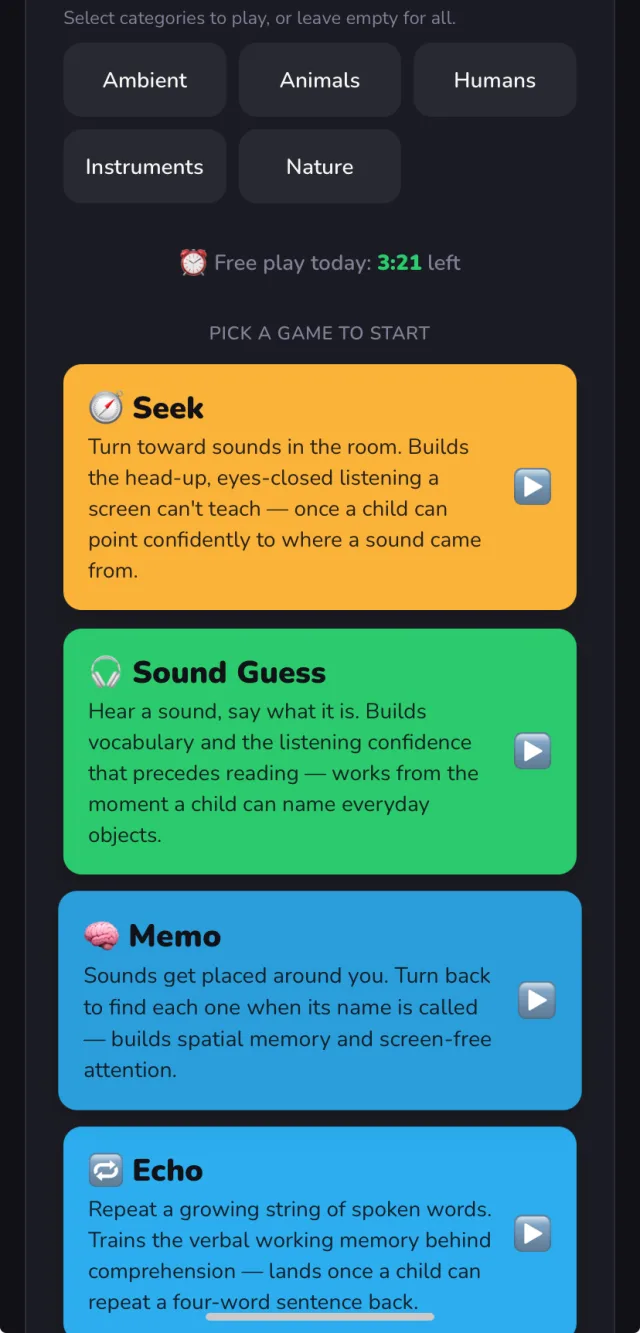
Soundame is a set of screen-free voice games for children 6 and up, and older kids and grown-ups play too. Four are playable today. Two are played by speaking: Sound Guess plays a real-world sound and the child says what it is; Echo says a run of words for the child to repeat back. Two are played by turning: in Seek a sound sits somewhere around the child, who rotates to face it; Memo places several sounds around the room, and the child turns back to the one that plays again. A fifth, First Sound, is coming soon: it plays one speech sound and names three words that start with it. There is no reading and no menu, the screen dims as the child gets rounds right, and the game is played by ear. It runs in a mobile browser, so there is nothing to buy to try it.
The honest limits: it needs a microphone and a reasonably quiet room for the speaking games, it is not a story player, and it is a young product made by an independent developer rather than a studio with a catalogue. English, German and Italian are live today; Spanish and Serbian are written and tested but not yet released.
Try a round of Soundame — free, no account, and it starts in the browser.